Advocate Health to boost employee compensation by $846 million in 2027
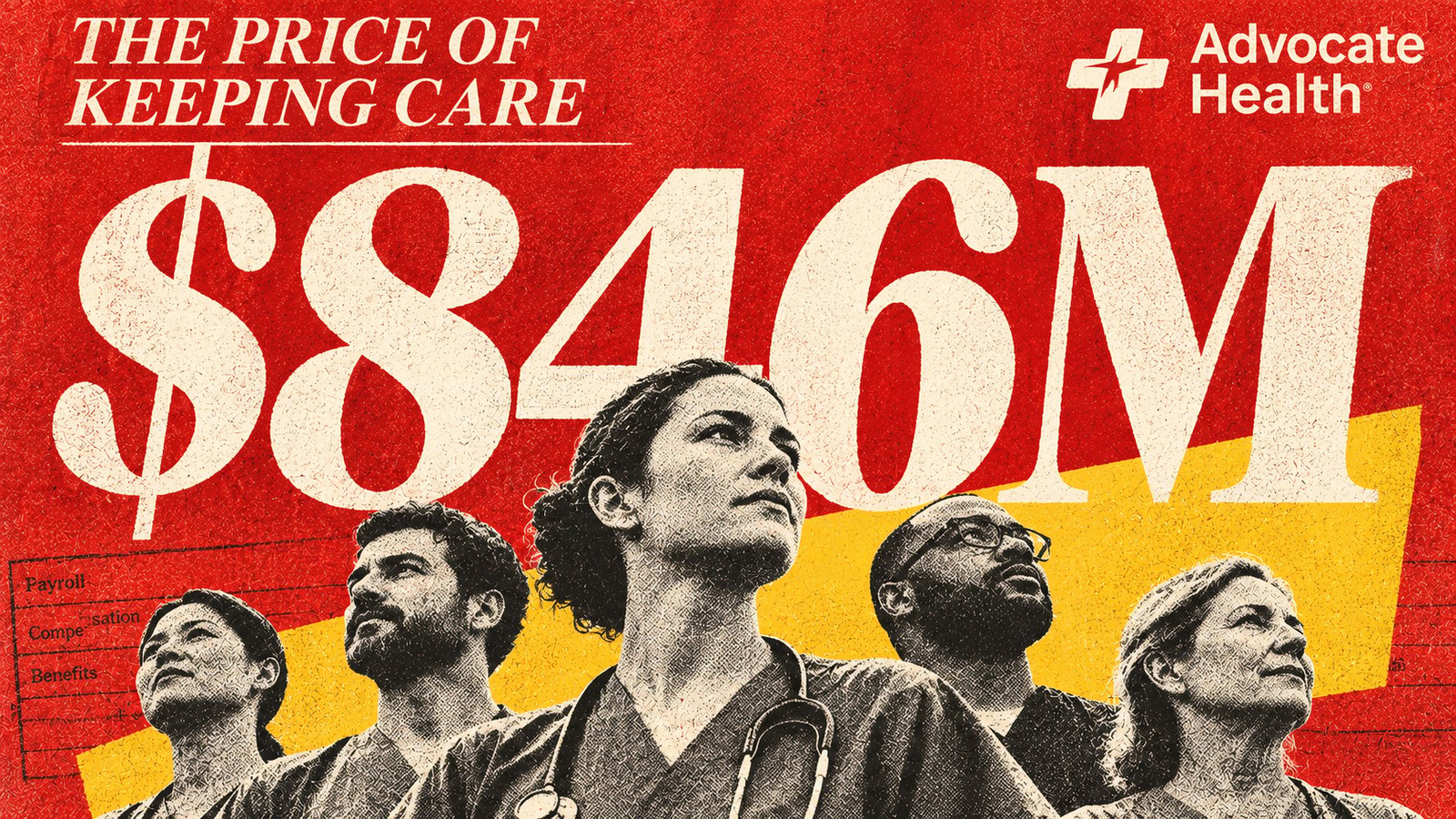
Advocate Health will spend $1.24 billion on its workforce in 2027, raising the minimum wage to $20 and adding $390 million in new benefits.
Key takeaways
- Advocate Health will allocate $846 million to direct compensation and $390 million to incremental benefits beginning in 2027.
- Expanded benefits include four weeks fully paid parental leave, enhanced bereavement leave, GLP-1 coverage, mental-health support and up-to-$21,000 in student-loan repayment.
Compensation Increase
Advocate Health’s 2027 workforce plan signals a decisive shift: $1.24 billion will be earmarked for employee pay and benefits, with $846 million earmarked for direct compensation. The nonprofit health system announced the plan on Nov. 5 and Fierce Healthcare reported the details. By raising the minimum hourly wage to $20—from $18.85 established this year—and adding merit increases, pay-range updates and other incentives, Advocate is betting that stronger financial support for its 170,000 teammates will translate into better care outcomes and staff retention.
The $846 million compensation infusion represents roughly two-thirds of the total $1.24 billion workforce investment. Beyond the floor, the plan includes merit-based raises and revised pay bands intended to keep salaries competitive with peer systems. Executives framed the move as the most strategic use of capital. “The most important investment we make isn’t in buildings, technology or equipment. It’s in our people,” said Eugene A. Woods, Advocate Health CEO, in a statement.
Expanded Benefits
The remaining $390 million will fund a suite of incremental benefits. Advocate already covers about 83 % of employee medical costs and will add $138 million to absorb more than 90 % of the projected $149 million rise in medical-plan expenses. New benefit enhancements include four weeks of fully paid parental bonding leave across the enterprise, expanded paid bereavement leave, continued coverage of GLP-1 medications for weight loss, and no-cost mental-health services for employees and their families. Retirement contributions will stay at up to 6 % of eligible pay, and education assistance will be available through more than 1,300 programs. Student-loan repayment assistance will cap at $21,000 for full-time staff and $10,500 for part-time staff over a lifetime.
Nakesha Lopez, senior executive vice president and chief people and culture officer, emphasized that “the benefits that matter most are the ones that make a real difference in people’s lives.” The package is timed to address multiple stages of an employee’s experience—early-career tuition assistance, mid-career wage growth, and later-stage retirement and family-leave needs—while keeping affordability front-of-mind for the organization.
Implications for Leaders
For CEOs and CFOs, the plan forces a recalibration of budget assumptions. The $1.24 billion outlay will likely reduce available capital for capital projects, technology upgrades or facility expansion unless offset by operational efficiencies or revenue growth. However, the investment could mitigate costly turnover, which industry data consistently links to higher recruiting, onboarding and lost-productivity expenses. In a competitive labor market, the wage hike positions Advocate ahead of many regional peers still anchored to lower minimums.
The decision also carries risk. If productivity gains or patient-volume growth do not materialize, the higher payroll burden could compress margins already under pressure from payer negotiations and rising supply costs. Moreover, the expanded benefits—particularly the expensive GLP-1 coverage and student-loan assistance—must be monitored for utilization rates to avoid unexpected budget overruns.
Action Plan for Leadership
- Model the cost impact – Run a scenario analysis that isolates the $846 million compensation increase from the $390 million benefits spend. Trade-off: granular insight versus time-intensive modeling.
- Align staffing plans – Adjust recruitment targets and internal mobility pipelines to ensure the higher wage floor does not create surplus labor in lower-margin service lines. Trade-off: tighter staffing control may limit flexibility.
- Track benefit utilization – Implement dashboards for GLP-1 prescriptions, mental-health visits and loan-repayment enrollments to flag early cost escalation. Trade-off: data collection effort versus early cost containment.
By embedding these steps, health-system leaders can use Advocate Health’s bold compensation strategy while protecting financial health.

Wearables and AI can narrow the gender gap in heart disease monitoring
Cardiovascular disease kills more women than breast, lung and chronic lung disease combined; WHOOP’s data and AI initiatives aim to provide gender-specific insights, requiring systematic integration.

FDA approves first factor XIa inhibitor to cut secondary stroke risk
The U.S. FDA’s clearance of Sunharbo (asundexian) adds a 26% risk-reduction option for post-stroke patients, but elderly bleeding risk requires careful use.

AI-driven virtual mental health startup Siggy launches with $6 million seed
Siggy debuts a free-intake, AI-augmented mental health platform that blends continuous digital monitoring with clinician-led therapy, backed by $6 million in pre-seed funding.