UnitedHealthcare rolls out Avery AI assistant to 21 million members
UnitedHealthcare expands its generative-AI companion Avery from an initial 6.5 million to 21 million enrollees, reporting 90% query resolution and a data-grounded design that underpins accuracy.
Key takeaways
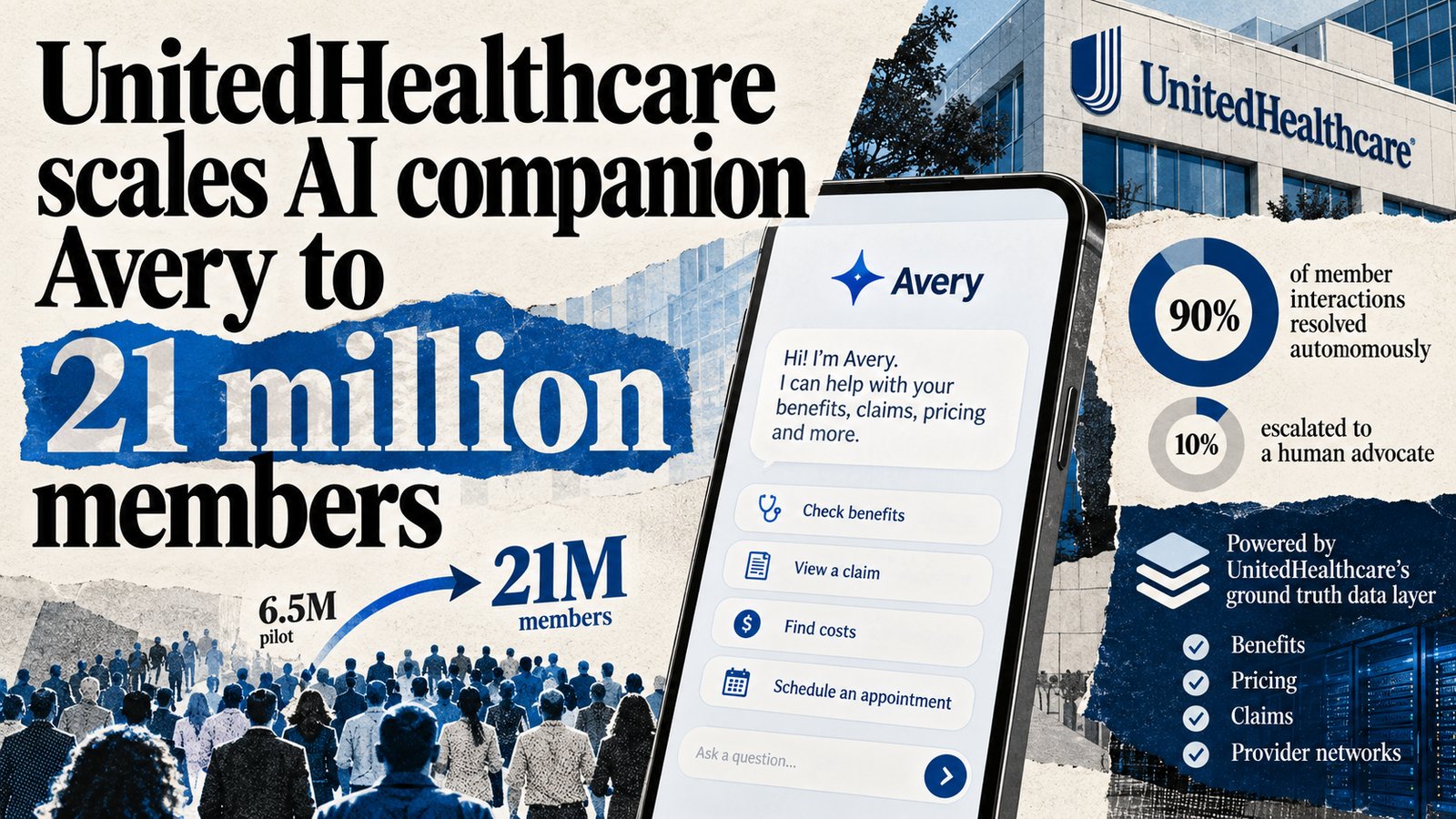
- UnitedHealthcare now offers Avery to 21 million members, up from an initial 6.5 million employer-plan members and 160 000 Medicare Advantage enrollees.
- Avery resolves 90% of member interactions autonomously and escalates the remaining 10% to a human advocate.
- The platform draws on UnitedHealthcare’s “ground truth” data layer to deliver accurate information on benefits, pricing and claims.
UnitedHealthcare is scaling its generative-AI companion Avery to serve 21 million members, a three-fold increase over its pilot rollout. The insurer says the expansion is driven by early performance metrics and a data-first architecture that underpins the tool’s accuracy.
Early results fuel rapid rollout
When UnitedHealthcare introduced Avery earlier this year, the AI assistant was limited to roughly 6.5 million members in employer-sponsored plans and 160 000 Medicare Advantage participants. According to the company, Avery has already resolved 90% of member interactions, with the remaining 10% handed off to a human advocate for support. Craig Kurtzweil, UnitedHealthcare’s chief data and analytics officer, told Fierce Healthcare that these statistics and positive user feedback “make sense to open up that application into more and more of the population.”
Data foundation drives member trust
Kurtzweil emphasized that Avery’s effectiveness rests on “ground truth systems” that create a critical data foundation. The AI sits atop UnitedHealthcare’s existing data layer, pulling real-time information on deductibles, out-of-pocket maximums, provider networks, pricing and claims processing. By delivering highly accurate answers, the platform aims to build trust and encourage broader member adoption.
Expanding functionality and ecosystem integration
Beyond answering benefit questions, UnitedHealthcare is adding capabilities that let Avery call providers and schedule appointments on a member’s behalf. This functionality targets friction points that often deter patients from seeking care. The move aligns with UnitedHealthcare’s broader strategy to empower members through plan designs like Surest, which feature variable copayments and give members greater control over cost-effective care choices.
Implications for health-plan operators
The rapid scaling of Avery illustrates how a payer can use a strong data infrastructure to accelerate AI adoption. For health-plan leaders, the UnitedHealthcare example underscores three actionable levers:
- Invest in a unified data layer – Build or consolidate member, claims and provider data into a single “ground truth” repository. Trade-off: upfront cost and integration complexity versus long-term AI accuracy.
- Pilot with clear success metrics – Track resolution rates and handoff ratios to gauge AI performance before broad rollout. Trade-off: limited early reach versus data-driven confidence for expansion.
- Layer incremental functionality – Start with benefit-info queries, then add transaction capabilities such as appointment scheduling. Trade-off: development time and regulatory review versus enhanced member convenience and reduced friction.
By following this staged approach, health-plan executives can replicate UnitedHealthcare’s expansion while managing risk and resource allocation.

Wearables and AI can narrow the gender gap in heart disease monitoring
Cardiovascular disease kills more women than breast, lung and chronic lung disease combined; WHOOP’s data and AI initiatives aim to provide gender-specific insights, requiring systematic integration.

Advocate Health to boost employee compensation by $846 million in 2027
Advocate Health will spend $1.24 billion on its workforce in 2027, raising the minimum wage to $20 and adding $390 million in new benefits.

FDA approves first factor XIa inhibitor to cut secondary stroke risk
The U.S. FDA’s clearance of Sunharbo (asundexian) adds a 26% risk-reduction option for post-stroke patients, but elderly bleeding risk requires careful use.